lara goldmann
Chapter 6.
Intra(mural) translation //
converging(out)//
Do You Wanna Mess With
This?!?
“[M]y own understanding of reading as an elaboration and complication of competing, overlapping, and complementary discourses.”2
“The traditional concepts in any discussion of translation are fidelity and license—the freedom to give a faithful reproduction of the sense and, in its service, fidelity to the word. These ideas seem to be no longer serviceable to atheory that strives to find, in a translation, something other
than reproduction of meaning.”3
So here we are again. Another exhibition, another site, or perhaps something altogether different, more along Richard Iton’s underground4. Or yet another way to approach Adam Pendleton’s first extensive solo appearance in Europe, Blackness, White and Light5, would be along Moten’s project/s6. This then in a Gramsci fashion. Thought sounded on yet another note, along some more poets raising the stakes like GangStarr’s Do You Wanna Mess With This?!?: “so if you stand in my way, I'ma have to spray/ Learn that if you come against me, son/ you’re gonna have to pray/ Since back in the day I held the weight and kept my head up/They wanna see the god catch an L, it's all a set-up/ I give no man or thing power over me”7. Something along these exhaustive overlappings, reaching into and sounding through so much/too much/never enough of all the centers of interpretation8. The poetics of exhaustion.
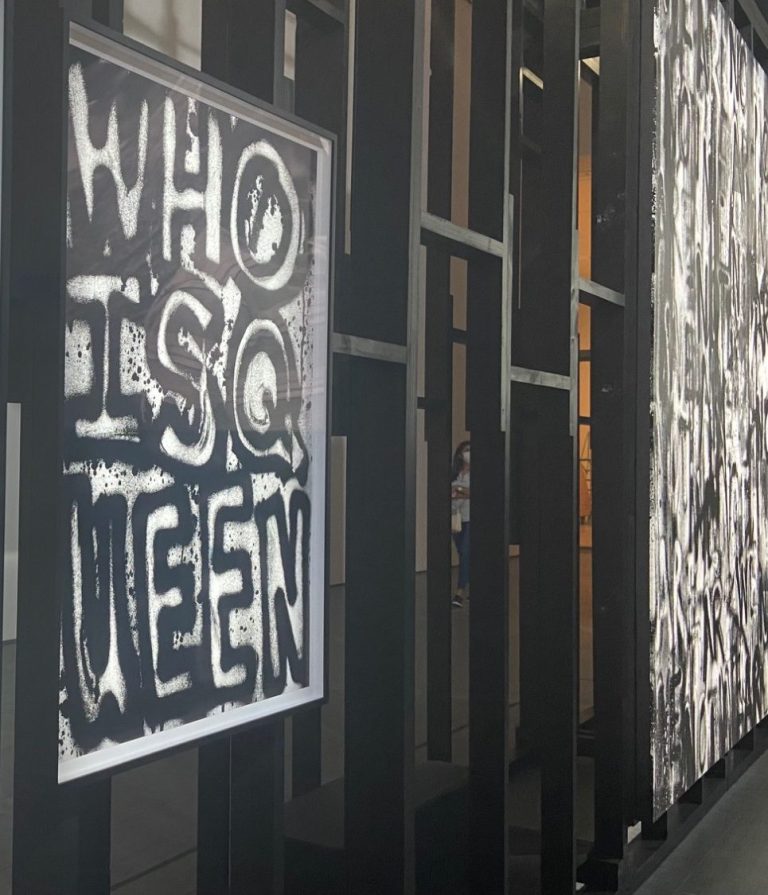
This 2023, intense exhibition at the mumok in Vienna, curated by Marianne Dobner, expands over two floors and presents an unparalleled richness to follow the many ideas that always keep playing with and against each other in Adam Pendelton’s iterations of core questions. To do so, we might endeavor into this depth by way of Hortense J. Spiller’s thoughts of certain centers of interpretation again that mark epistemological fields that cannot hold what they lay hold on. So we can find, then, along some of those centers that she suggests, and where we will certainly cross James A. Snead, some guidance. So that the centers, and the interpretation, and certainly the fields, swirl some more and totally spiral ourthoughts beyond of the pull of gravity and yet, keep us bound to the committed study of finding more counter moves.Those two critical minds, Spiller and Snead, like perhaps no other critical thinkers, diligently and thoroughly move towards a mapping of a certain convergence of densities that move outwards as escape by way of translating. Always deeper into interwoven text/tures, always in and always already somewhere much further than what seems to move across the interface of the lettering fabric. So we keep their thoughts in mind all along the many paths. Taking up the task of translating way beyond Walter Benjamin’s notions but always with a certain tone, the Benjamin tone, close by. Which, then, throws us right to where we find ourselves, in Pendleton’s Blackness, White and Light digging deep into a certain kind of spatial manifestation of all that critical stuff going on, as in intramural converging. But in outward motions, within and farther so to speak—and linger within Spiller’s Black, White and in Color, or Learning How to Paint: Toward an Intramural Protocol of Reading. Perhaps joining together two disorderly epistemological fields into an intramural ex//position. Although the title of text and exhibition seem a bit blunt set side by side, that stark resonance there is indeed a conversation that seems relevant to both. The site of an intramural ex//position. These moves are less of a settled showing and much more a forceful making. Putting all those thought-forces of Spiller’s text(s) into play with those questioning demands of Pendleton’s work, we see these words, marks, gestures and color a little denser, and in an immediate resonating sound-field that sits along and besides those two thinkers. And yes, as the titles suggest, there is color in Blackness, White and Light, lights of ultra/viole/(t)/nce. There is always more than black and white whichever way you translate those modes into the world. Without consideration of their prismatic complexities, they are so often reduced to the notion of black(ness) and white (ness) as two binary modes of ordering the social relations of our geopolitical maneuvering–and how we conduct ourselves according to it. So the suggestion of this ex//position seems to complicate the way we translate those modes into the world and to take aim at that violent production which defines black and white as the primary mode of a horribly reductive andviolent way of relating. Of seeing. Here, in the simplest terms, blackness, black and white with some color turns into light/ning, complicated by centers of pressure that are neither black nor white but energetic rays resonating—with a new rhythmic frequency— and setting off grumbling fields of clashing particles. Because the Ultralight Beam(s)9 are always there in their energetic particles. A besideness that moves into expansion always staying close to what keeps on going.
It bears repeating how Pendleton defines the ex/position: “The guiding principle of Blackness, White and Light is the compositional logic of we—not an exclusive we (us versus them) but an inclusive we, a nonidentical we. A dark, dissonant, contradictory we. Composing in this mode is a process of accumulation, a visual chorus of marks, and voices, held in tension.”10 Blackness, White and Light, indeed an accumulation—across two floors and through many turns, includes 95 works—paintings, drawings on paper, canvas, mylar, or onto ceramic sculptural plates, as well as short films. Some works such as the Days11, the Untitled (Anthology)12, the Untitled Compositions13, Systems of Display14 , or the (Untitled) Code Poem15come in series. Works on mylar, canvas, mirrors, ceramics and plexiglass form a visual chorus in formation across a long passage, suggesting nothing less than the longue durée.16
Other works in the ex//position seem to stand alone. But not quite. Here everything is always in conversation, or in a suspended conversation, with other loosened parts, dispersed across the space and around the corners. Some are almost monumental, such as the work WE ARE NOT17, or Black Dada (A/D)18, and Black Dada (C/L),19 continuing through various alphabetical notions, always in motion, converging only to break apart. The entire architectonic figuration in itself, as a site, marks a work of its own, which is the wholeness of everything else. With its wall fragmentsinterspersed and built into the rooms and geometric disruptions through odd angles, Pendleton sets a complicated stage, a ruptured realignment, a coming together of non-consequential consequences of anincursion into an energetic vibration of resonating particles. As Pendleton puts it “an astounding potential in collective difference.”20 An acutely intense difference that keeps putting everything and all in a collective visual field of idea-networks. And with tension that keeps pushing and pulling. Pulsing. The architectural surroundings have been created simultaneously with the works, an intentional force of agonizing attention, disrupting the whole, submerging and suspending any foreclosure or completion and breaking into arrhythmic beats. A rigid, severe architectural composition that keeps falling into disorder as an architectonic acoustic sounding hall for dissonant tones. As Pendleton puts it “the visitor, physically implicated in the work but also a cognizant participant, comes to the encounter loaded with a new critical apparatus.”21 The architectonic re-figurations indeed force us onto ourselves as we try to access, try to order our way through angles and turns. This then puts us into conversation with Spiller’s reading of Paule Marshall’s work in Chosen Place, Timeless People, where Spiller invokes, as she writes in “Black, White andin Color”, “an epistemological ground for locating centers of interpretation.”22 Thrown into Pendleton’s exposition(s), our general understanding of interpretation as we encounter an exhaustive array of epistemological fields is confronted by an astute loss of certainty. Centrality of perspective slips away as we are implicated within those fields, submerged and suspended, as our very presence is central to the slipping centrality.
We cannot, might as we try, not be interpreting our presence along or besides this all-over-ness, forcing us into a total
epistemological un-knowing gravitational pull thatputs us up for question. It insists on our presence as something that is there and not there. Normative ideas of knowledge as a concept of understanding and ways of interpreting and sense-making break down in confrontation with those unfinished words and sentences, the inaccessibility of total over/sight. We have to rely on something other than what we know. We cannot rely on familiar frames of understanding as we are being used up using those abstract codes. Codes that only always suggest or speak in incomplete difference and contradiction, which by highlighting our agency here suggests we are implicated in all of it. This feels a lot like Spiller’s thoughts: “One might attempt to forge, realizing this, a “critical pertinence” that would mobilize, at least implicitly, its own ideological biases, perhaps even use them, that would recognize the play of contradiction and difference, as an aspect of her own critical project.”23 It is we who have to make sense of this. A critical architectural project, a project criticizing our geometric reasoning, the always present architectonically structured conversations in which we are embedded. This ex//position draws us out of any mindlessness, it puts us on alert, we feel what we cannot know and cannot fully face. Pendleton, in various talks as well as in his writings, has spoken about his idea of a certain “geometry of attention”. In a talk with Meredith Malone at the Mildred Lane Kemper Art Museum in 2023, he suggests to expand and think with attention as well as along a “geometry of intention.”24 Which then is right at the center of interpretation thatSpiller suggests, The intention we inadvertently bring to interpretation, perhaps even consciously engage–to advance our own critical project–is confronted with an epistemological field as well as a vernacular one. It messes up the attention to see the intention within. At the same time we are architecturally interpreted as well, into our positions, in these epistemological fields.
What seems crucial here is that there is this breakdown of contradiction and difference in the face of an intention for interpretation as our own critical project. Which we can also recognize as a critical and dangerously playful projection. It does indeed require a geometric converging of attention to consider all that is resonating through that tensioning up. A tension that inadvertently throws oneself into astark problematic. It is precisely the problematic of coming to terms or coming out-of-the-terms of a haunted oneself/ness, the self-centered I. That I that cannot help but feel/or fear that it is a negation. Which is the fundamental problematic at the center of all epistemological fields, that needs to be tended and cultivated in a differentiated ge(c)ological contra-movement. Scrutinizing the determined self’s intention/interpretation, and undertaking a critical dangerous play of understanding that contradictory tension. How do we negotiate self in the face of a totally abstract geometry of all other interpretations messing that self’s intention up? The tension we feel as we encounter this expansive architectonic space of objects, and as they bounce off of each other–in a physicalparticle (kinda universal) very particular turbulence–it feels a lot like Aira Dean’s thoughts on this abstract density. The parasubjectivity’s emergence into our contemporary epistemological field that puts everything to question. “The objects both imply and suffer from an interpretive problem—which is not to say that they are divisive but that they illustrate the very problem of interpretation itself, and therefore the very problem of subjectivity.”25 Please bear with me for a moment because it might get really messy, which is what happens when you play around. But since the messiness of the world in general overwhelms and stuns, playing might be a way forward in this experimental site that opens up. So we might bring some invention as well as strategy into this play-ground. We shall keep returning to why Pendleton’s Blackness,
White and Light might be such a generative play-grounding to get started.
1 Gang Starr. “Full Clip.” Full Clip: A Decade of Gang Starr, produced by DJ Premier and Guru, Virgin Records, New York, 13 July 1999.
2 Spillers, Hortense J. “Black, White, and in Color.” In Black, White, and in Color: Essays on American Literature and Culture, The University of Chicago Press, Chicago and London, 2003, p. 279.
3 Benjamin, Walter. “The Task of the Translator.” In Writings: Volume 1, 1913–1926, edited by Marcus Bullock and Michael W. Jennings, The Belknap Press of Harvard University Press, London and Cambridge, 1996.
4 Iton, Richard. In Search of the Black Fantastic: Politics & Popular Culture in the Post-Civil Rights Era.
New York, NY: Oxford University Press, 2008.
5 Pendleton, Adam. “Blackness, White, and Light.” mumok, 31 Mar. 2023–7 Jan. 2024, https://www.mumok.at/en/exhibitions/adam-pendleton-blackness-white-and-light.
6 Moten, Fred. “The Gramsci Monument.” In The Little Edges, Wesleyan University Press, Connecticut, 2016.
7 Gang Starr. “Full Clip.” Full Clip: A Decade of Gang Starr, produced by DJ Premier and Guru, Virgin Records, New York, 13 July 1999.
8 Spillers, Hortense J. “Black, White, and in Color, or Learning How to Paint: Toward an Intramural Protocol of Reading.” InBlack, White, and in Color: Essays on American Literature and Culture, The University of Chicago Press, Chicago and London, 2003.
9 West, Kanye. “Ultralight Beam.” The Life of Pablo, G.O.O.D. Music, Def Jam Recordings, and Universal Music Group, 14 Feb.2016. Produced by Kanye West, Chance the Rapper, Swizz Beatz, Mike Dean, Plain Pat, Noah Goldstein, DJDS, and Rick Rubin.
10 Pendleton, Adam. “Preface.” In Blackness, White, and Light, Museum moderner Kunst Stiftung Ludwig Wien / Verlag der Buchhandlung Walther und Franz König, Vienna and Cologne, 2024, p. 6.
11 Pendleton, Adam. “Untitled (Days) 2022.” In Adam Pendleton: Blackness, White, and Light, Museum moderner Kunst Stiftung Ludwig Wien, 31 Mar. 2023–7 Jan. 2024..
12 Pendleton, Adam. “Untitled (Anthology) 2017–2023.” In Adam Pendleton: Blackness, White, and Light, Museum moderner Kunst Stiftung Ludwig Wien, 31 Mar. 2023–7 Jan. 2024.
13 Pendleton, Adam. “Untitled (Composition) 2022.” In Adam Pendleton: Blackness, White, and Light, Museum moderner Kunst Stiftung Ludwig Wien, 31 Mar. 2023–7 Jan. 2024.
14 Pendleton, Adam. “System of Display Z (HAZE/Composition), 2022.” In Adam Pendleton: Blackness, White, and Light, Museum moderner Kunst Stiftung Ludwig Wien, 31 Mar. 2023–7 Jan. 2024.
15 Pendleton, Adam. “Untitled (Code Poem), 2022.” In Adam Pendleton: Blackness, White, and Light, Museum moderner Kunst Stiftung Ludwig Wien, 31 Mar. 2023–7 Jan. 2024.
16 “French Annales School approach to the study of history […] It gives priority to long-term historical structures. [..] It concentrates on all-but-permanent or slowly evolving structures, and replaces elite biographies with the broader syntheses ofprosopography. The crux of the idea is to examine extended periods of time and draw conclusions from historical trends and patterns.” https://en.wikipedia.org/wiki/Longue_durée.
17 Pendleton, Adam. “Untitled (WE ARE NOT), 2022.” In Adam Pendleton: Blackness, White, and Light, Museum moderner Kunst Stiftung Ludwig Wien, 31 Mar. 2023–7 Jan. 2024.
18 Pendleton, Adam. “Black Dada (A/D) 2022–23.” In Adam Pendleton: Blackness, White, and Light, Museum moderner Kunst Stiftung Ludwig Wien, 31 Mar. 2023–7 Jan. 2024.
19 Pendleton, Adam. “Black Dada (A/D) 2022–23.” In Adam Pendleton: Blackness, White, and Light, Museum moderner Kunst Stiftung Ludwig Wien, 31 Mar. 2023–7 Jan. 2024.
20 Pendleton, Adam. “Preface.” In Blackness, White, and Light, Museum moderner Kunst Stiftung Ludwig Wien / Verlag der Buchhandlung Walther und Franz König, Vienna and Cologne, 2024, p. 6.
21 Pendleton, Adam. “Preface.” In Blackness, White, and Light, Museum moderner Kunst Stiftung Ludwig Wien / Verlag der Buchhandlung Walther und Franz König, Vienna and Cologne, 2024, p. 6.
22 Spillers, Hortense J. “Chosen Place, Timeless People: Some Figuration on the New World.” In Conjuring: Black Women,Fiction, and Literary Tradition, edited by Marjorie Pryse and Hortense J. Spillers, Indiana University Press, Bloomington, 1985, p. 277 (Note 6).
23 Spillers, Hortense J. “Black, White, and in Color, or Learning How to Paint: Toward an Intramural Protocol of Reading.” InBlack, White, and in Color: Essays on American Literature and Culture, The University of Chicago Press, Chicago and London, 2003, p. 277.
24 "Adam Pendleton: To Divide By" at the Mildred Lane Kemper Art Museum. September 22, 2023, Pendleton with curator Meredith Malone. https://www.youtube.com/watch?v=fTN204gFELU
25 Dean, Aria. “Ground Zero.” In Bad Infinity: Selected Writings, Sternberg Press, London, UK, 2023, p. 27.