lara goldmann
Migratory
Back then, in Mexico City, sitting in the sun-flooded studio of the artist Minerva Cuevas, the sound from the nearby Plaza de la Constitución, El Zócalo drifting in through the open window, back then, the buzzing air of this beautiful city, the quiet concentration in the studio, back then, it seems like a long time ago.
We were looking at a new work, Disidencia, mesmerized. It spoke to the times, here but also there, it spoke to the times, now but also then, and certainly tomorrow. It still speaks. To now, but also to then. And certainly tomorrow.
The pulsing force of the many, coming together, moving, not towards but from within— in dissidence—as a life-affirming practice across communities, a celebration of a voice, the voice of the many, a voice of all tonalities, a polyphonic texture, reclaiming and announcing a ‘Yes-But-Different’.
It seems like a long time ago, and yet as present as yesterday, for when we thought everything stopped, it somehow did. The streets empty, no sounds filling the air
but for the birds and the ambulances. A fragment of linear time - cut out.
Yet
there are other times. Other spaces. Throughout and within them, things didn't stop.
Everything kept moving. That is what we do. That is what the world around us does.
That is when we are close to that which is
always within us.
Migratory
Then when everything seemed to stop, here, when there was a quiet, this quiet—but for the birds and the ambulance—something stopped and we started to hear, we started to hear our thoughts thinking.
We heard our thoughts thinking that maybe we had to adapt. Maybe repeating and pretending to be in a world adapting to our liking, perhaps that idea had used itself up.
Maybe we had to adapt. Have to.
Apparently. Indeed. Very much so.
But what does that mean,
how do we think of a moment, that moment, when everything stopped and we started to hear?
Perhaps the question is not so much how we reconsider our relation to the world
but how
we reconsider our relation to each other.
The stable, composed voice of the boy—isn’t he telling us something about how we relate,
something about The Poor Man, the Rich Man and the Mosquito?
Simple. His voice making us halt, listen.
Reconsider. Our relation to each other within this world.
El pobre, el rico y el mosquito/The Poor Man, the Rich Man and the Mosquito
Are we not already reconsidering our relationship to each other?
Right now. Here?
The work of Minerva Cuevas, in many ways, is that moment of “everything stopping”, the sudden halt, and we stand and we get a chance to look and hear and our reasoning begins to crumble. Reality looking a bit absurd, the reasons a bit hollow, and we have that moment to ask - really? There is a challenge, and there is a relief, once we ask - really? Is this what we agreed on? Is this the only way we can relate to each other? This world, the only world we can understand? This, the only way to move through it?
In that halt, there is an opening to walk in the other direction, unknowing but in relation, because maybe we do know - really. Maybe we can imagine other ways of moving through this world. It is possible to change Evian to Egalite. It is possible to push and crash into Shell, into Esso, it is possible to wreck them. It is even enjoyable. We catch ourselves laughing. Together. A relief. And a different energy, the energy of the release and recharge, and the energy there in the Plaza de la Constitución, El Zócalo. A relational, transmissive, contagious energy. With and for each other.
And it is possible to unmask Del Monte’s luscious fruits as the poison wrecking our worlds, possible to make chocolate taste bitter. It is possible to speak and listen without words, possible to look at a different reality, a reality that warns us, and that invites us, that demands of us, a warning inviting us by simply making us halt for a moment, in the moment, and wonder - really? An opening that wants us to be present.
Now, here…which means then and there as well.
Presence is not a state. It is a movement. Active and with one another. Our presence re-shifting our relations to each other, making them conceivable, our presence being how we come to be in relation at all, every moment again and from a new perspective having taken a step back, to the side, forward. Turn around. What do you see, who do you see? Are you here?
Isn’t that what works of art can do? Create a moment, a space in which everything stops, but only for a moment, now, and then opens a space to move, different, reconsidered, you are here, we are here, and here is the work and the possibility to move differently, the work only being the opening it can be because we are here. Now. Halting. Reconsidering. Imagining a new way of moving. Reconsidering each other, the work and what opens when we are present.
A different way of knowing, understanding, a different relating to time and space. We know that. We can hear it.
Cuevas’ work has always explored the boundaries of our conventional “principle of things”, our “way of being”. Her work has always questioned our acceptance of those principles. Embracing the absurdity, contextualizing history from different perspectives; ridiculing structures of power, making us either laugh bitterly or walk with growing concern but always realizing that perhaps we are not as bound to these systems as we thought. And that we perhaps too easily accept. And if we start moving closer to each other without keeping the distance drawing us further and further apart, we can be present together. Can move with the energy coming from being present, with each other, and trying to relate anew.
Shift our position, change the direction of our steps. Pay attention to who is beside us,
moving in the presence we share.
The works make us remember, remember that we know and knew and kept up realities that seem impossible, that, we also know, are realities detached and isolated from each other and the world we move through.
We know that knowing isn't quite what we thought it was. We remember, we can move the other way around.
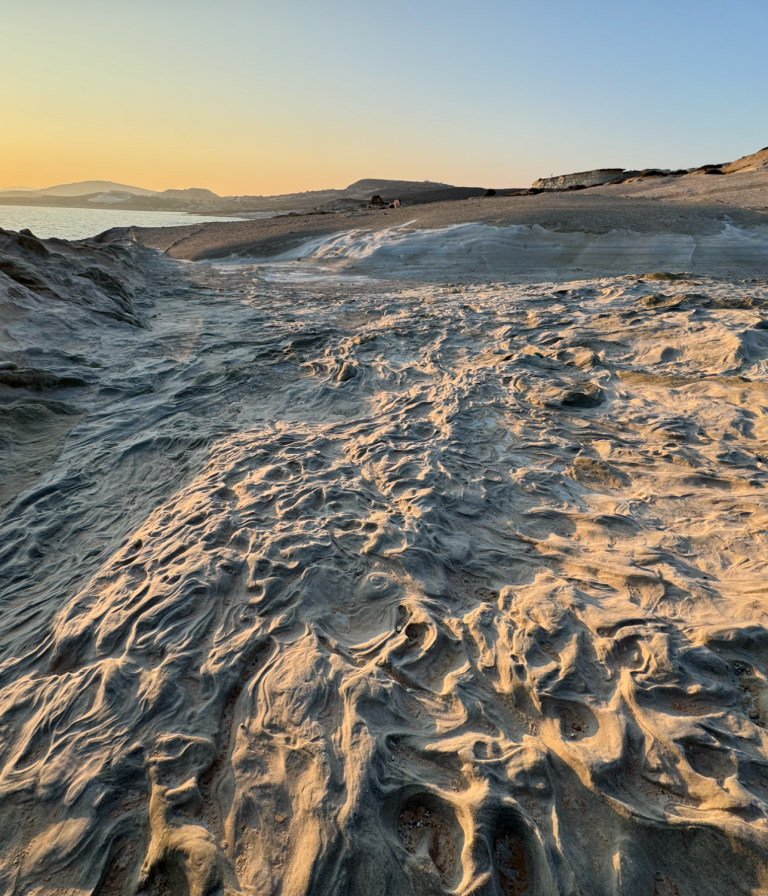
We look at the sand and the dust beneath our feet and we realize, it is a canvas.
We can imagine a new reality. In that dust, in that sand.
We can imagine in doing.
And there are no rules, we remember, there are no rules, the unknowing and imagining and reconsidering each moment anew - it cannot be regulated, cannot be systemized, it is moving. Here, then and now, and there - is an invitation - being in presence with that imagining. A moving promise, always here and there…not-yet-but, what would it feel like, really, living and breathing in that promise.
There is a curiosity there.
Here.
Wondering.
Wandering.
Lara Goldmann, December 9, 2021.